Written by Dr. Annie Cole, Lead Researcher │5 minute read
Your online funnel has one job: To generate leads, contacts, and sales.
But what happens when your funnel isn’t… funneling? What should you do?
This ultimate guide will walk you through, step-by-step, how to fix a leaky lead magnet or sales funnel that just isn’t giving you the results you want.

What is a Leaky Funnel?
A leaky funnel is any stage of your online funnel where interested people quietly drop off instead of becoming leads or customers. To fix it, you first diagnose which stage is leaking, then use customer data to redesign your offers, messaging, and UX at that stage.
What Causes a Leaky Funnel?
A leaky funnel happens when people move through the early stages of your funnel but fail to take the next step, like joining your list or becoming a paying client. Each stage can leak for different reasons: awareness, interest, engagement, trust, or the offer itself.
Before you can fix a leaky funnel, you need to understand how a funnel actually works. A funnel is made up of several parts, and some parts of your funnel may be working beautifully - while others are not.
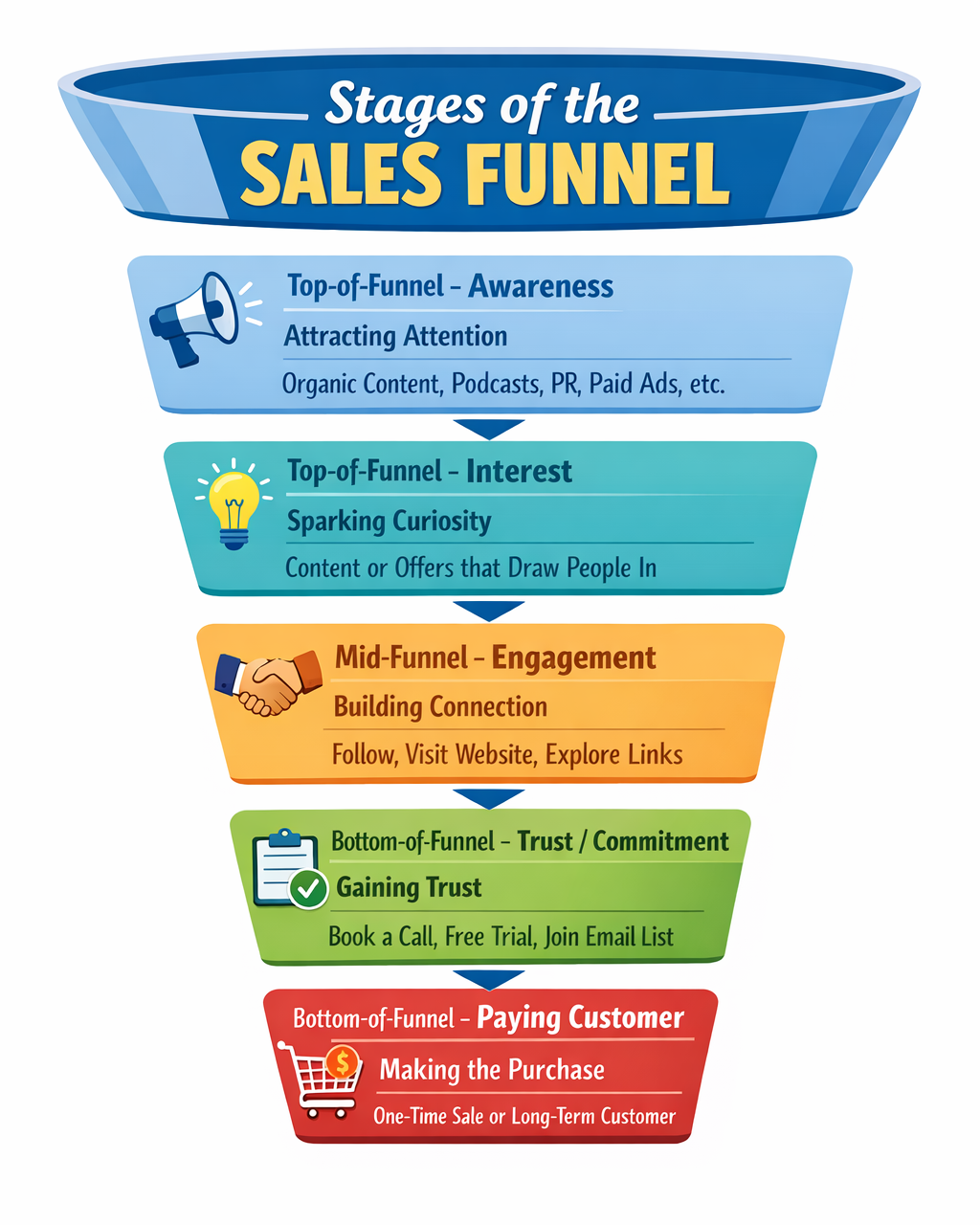
Top-of-Funnel - Awareness: How you’re getting people’s attention and drawing them in (organic content, podcast, PR, paid ads, etc.)
Top-of-Funnel - Interest: Usually some kind of content or offer that piques someone’s interest and makes them want to learn more about your and / or your business.
Mid-Funnel - Engagement: The point where someone decides to engage with you (example: follow you on social media, visit your website, explore your shop or links).
Bottom-of-Funnel - Trust/Commitment: The point when someone has learned enough about your / your business that they decide to engage further to either book a consultation, sign up for a free trial, download a lead magnet, join an email list, etc.
Bottom-of-Funnel - Paying Customer: The point when someone makes a paid purchase. This may be a one-time purchase, or they may become a long-term paying customer.
Which Part of Your Funnel is Leaking?
As a business owner, this is the number one question you need to be asking yourself before you take ANY action to fix your funnel. Think about these scenarios:
Your Top-of-Funnel may be overflowing (you have lots of followers, users, people aware of your business) but your Bottom-of-Funnel needs work (you aren’t building trust and converting users to paid customers).
Alternatively, you might have a Top-of-Funnel problem if no one knows about you (in which case, you need to focus on awareness building activities.)
This is exactly why you need to understand what is and isn’t working in your funnel before you take any actions.
How to Identify Sales Funnel Leaks
To identify the leaks in your current funnel, ask yourself the following questions:
How do I check my top-of-funnel (Awareness)?

Ask yourself:
Do people know that my business exists?
Am I growing in visibility (website traffic, social media engagement/followers, PR or other marketing efforts are working)?
How do I check my top-of-funnel (Interest)?

Ask yourself:
Once people find out about the business, do they stick around?
Are people saying things like ‘This resonates with me’ or ‘I’ve been looking for a solution like this’?
How do I check mid-funnel (Engagement)?

Ask yourself:
Do people engage with your content, blog, newsletters, videos, shop items, lead magnets?
Are you seeing growth in engagements over time?
How do I check bottom-of-funnel (Trust)?

Ask yourself:
Do you have strong trust-builders in place to show people that you are credible (media features, testimonials, reviews, free trials, etc.)?
How do I check if my offer is the problem?

Ask yourself:
Are the products or services I sell resonating with users enough for them to pay for them?
Is there market demand for my product?
Is it competitively priced?
Do my free trials or consultations tend to convert to paying clients?
How to Fix Your Leaky Funnel
Once you know which part(s) are broken, you can start fixing your funnel with confidence. In this phase, you’ll want to not only identify the leaky area, but also use customer data to inform the funnel fix.
How to Fix a Leaky Funnel: Step-by-Step Instructions
1. Pinpoint exactly where people “fall through the cracks”
Start by sketching your funnel as a simple timeline of moments, not a fancy diagram.

At each point:
Write the concrete action you want people to take.
Click a link, join the list, book a call, and/or buy the thing.
Then, note roughly how many people actually do it.
Look for the spots where interest suddenly evaporates.
Maybe people love your posts but never click through, or they join your list but rarely open launch emails.
Those “silent exits” mark your real leaks and give you a clear starting point instead of trying to fix everything at once.
2. Go talk to the humans stuck at that stage
Once you know where the leak is, stop guessing and go straight to the people who stalled out there.

Specifically:
Invite them into short conversations.
Send a tiny survey.
Add one quick question to your unsubscribe or “didn’t book” workflows.
Keep it low-friction and respectful of their time.
Ask curious, open questions that get behind the polite answer. Instead of “Did you like this?” try “What made you hesitate?” or “What were you hoping to find but didn’t see?”
The goal is to understand their decision-making moment and dial into what they noticed, what confused them, and what would have made it easier to say yes.
3. Let their words reshape your messaging, offer, and path
Take the language your customers actually use and let it rewrite that leaky part of the funnel.

If they say, “I wasn’t sure what I’d get out of this call,” your heading becomes, “What you’ll walk away with from this call.”
If they say, “It felt like too big a commitment,” you might break the offer into a smaller first step or add a clearer risk-reducer.
Then walk through the experience like a new visitor. Trim extra choices, clarify jargon, and reorder information so the most reassuring details show up before you ask for a decision.
The test is simple: can someone skim that page or email and instantly see what the next step is and why it’s worth taking?
4. Run small experiments and let the data nudge you forward
Rather than rebuilding your whole funnel overnight, treat each change as a tiny experiment.

That can mean that you:
Swap one headline.
Adjust one offer.
Shorten one form.
Change one email sequence
Then, give yourself a defined window to watch what happens.
Track just a handful of metrics tied to that stage, like click‑through rate, opt‑in rate, or consult‑to-client conversion. If the numbers move in the right direction, keep that change and build from there.
If they don’t, you haven’t failed; you’ve learned something about what doesn’t move your people, and that insight makes the next experiment smarter.

The best funnels?
Focus on one thing: The target audience (who they are, how they speak, and what they need).
Examples of Leaky Funnel Fixes
Here’s an example of what the process looks like to fix your funnel in real life.
Leaky Funnel Fix: Example #1
LEAKY AREA: Bottom-of-Funnel - Paying Customer: Let’s say you have a massive following on social media + a large number of newsletter subscribers, but not many people funnel down to become paying customers.

CUSTOMER DATA:
You survey your newsletter subscribers to see which potential products they would be most interested in purchasing.
To your surprise, 80% want to pay for 1:1 coaching, not something passive like your book (which you’ve been pushing as your primary product).
LEAKY FUNNEL FIX: Based on the survey data, you develop a new 1:1 coaching offering and start promoting it on your channels. You see sales increase as a result of making this informed shift.
Leaky Funnel Fix: Example #2
LEAKY AREA: Top-of-Funnel - Interest: You’re a newer business in the health & wellness with low visibility. You know that people will absolutely LOVE your products - once they find out that you exist.

CUSTOMER DATA:
You conduct mini user-interviews with 10 people in exchange for a $10 gift card (or free giveaway item). During the interview, you ask them how they get their information each week about new health & wellness trends. You learn that 9/10 people read The Healthy Human newsletter every single Sunday.
LEAKY FUNNEL FIX: Armed with this information, you reach out to The Healthy Human team and ask if you can share your information in an upcoming newsletter; you end up negotiating a paid advertisement that lands you tons of warm leads that you can start nurturing.
Frequently Asked Questions
-
You should review your funnel at least once per quarter, and any time you launch a new offer, change your pricing, or see a sudden dip in leads or sales. Regular check-ins help you catch small leaks before they turn into major revenue problems.
-
A funnel problem means people are dropping off because of how you present or deliver the journey. An offer problem means the product or service itself doesn’t feel valuable or relevant enough to your audience, even if the funnel is smooth.
-
A simple sales funnel usually starts with attention-grabbing content (like a social post, blog, or ad) that gets someone to click because it clearly speaks to a problem they want solved. That click sends them to a focused lead magnet landing page where you offer something specific and valuable (like a checklist, mini training, or template) in exchange for their email address. After they opt in, you send them to a thank-you or confirmation page that can introduce a low-friction upsell or “next step” offer, such as a paid workshop, starter service, or low-ticket product. From there, a short email sequence or retargeting flow nurtures trust, shares proof and stories, and guides them toward a main sales page that clearly explains your core offer, why it matters, and exactly how to buy or book.
-
If you see steady traffic but very few sales, there is likely a leak in the middle or bottom of your funnel. People are finding you but not getting enough clarity, trust, or motivation to take the next step toward becoming a customer.
-
You can often see early signals, like higher click-through or opt-in rates, within a few weeks. More stable changes in sales and revenue usually show up over one to three months, depending on your traffic and offer.
The Leaky Funnel Solution?
It’s All About Your Customers
If there’s one thing you take away from this article, I hope it’s this: A strong funnel of any kind is built on an even stronger understanding of your target customers. They should inform everything you do - from top of funnel attraction to bottom of funnel product offerings.
The key to fixing a leaky funnel usually comes down to a better understanding of what your customers want and need.
Here at Praxia Insights, that’s exactly what we help businesses like yours achieve - a deeper understand of what their customers truly think, feel, and want.
Let's Fix Your Leaky Funnel
If you’re feeling frustrated with your funnel results (or lack thereof), you’re not alone. We work with businesses every single week who are struggling to understand why their funnels aren’t working - and what to do next.

Here’s how we can help you fix your leaky funnel:
Funnel Audit: Our trained experts can review your current funnel and highlight areas that might be causing bottlenecks.
Market Research: We’ll scope out your competition and show you what’s working well in their funnels - as well as show you how to make yourself stand out in a sea of competition.
User Research: We can conduct surveys, 1:1 user interviews, and focus groups with your target audience to get you first-hand feedback on what people really think about your funnel, content, and products.
UX and Usability Studies: We can conduct UX studies with your audience and watch them interact real-time with your website, funnel, content, or products through observations, screen recordings, website/product testing studies, diary studies, and more.
We specialize in helping entrepreneurs and small businesses conduct research to improve their lead generation and sales processes.
Interested in learning more? Set up a complementary consultation to see how we can help you fix your leaky funnel today.
Get a Free Funnel Audit
Share your funnel with us and we’ll review your funnel for free, offering specific recommendations on how you can fix the parts that aren’t working.